Saturday, July 9, 2011

My Buffalo News Interview on BeeKeeping

Last week the Buffalo News' Anne Neville interviewed myself and my beekeeping mentor, Steve Mead, about the fine art and science of bees.  The article turned out really nice!  Great photo by Robert Kirkham of the Buffalo News as well.  Enjoy!  (article below and link to online version here: http://www.buffalonews.com/life/article482260.ece )


Eric Kancar, dressed in his protective beekeeping gear, tends to the hives in East Aurora.
Robert Kirkham / Buffalo News


Updated: July 8, 2011, 2:58 PM
Eric and Sarah Kancar live on a 3.5-acre hobby farm in East Aurora with two horses, eight cats, two dogs, a small flock of chickens and a spoiled potbellied pig adopted from the SPCA. In the spring, their animal census increased by 3,000 to 5,000 when a buzzing, three-pound package of bees arrived from an apiary in Ohio.
The bees, complete with a hardy Russian queen, arrived in early May to replace the colony of bees that had not survived the winter, Kancar's first as a beekeeper.
Although last year's colony filled the hive with heavy deposits of beeswax and honey, the bees died off after their finely honed, intuitive system was disrupted by a series of natural events that included a swarm, when the hive splits in two and half the bees fly off with a queen.
Kancar found the loss of his colony sad and disappointing, but as he narrated events on the blog he writes about his farm (http://czarofthewoodsfarm.blogspot.com) it was clear that he was hooked.
Kancar is not alone. The buzz is growing about these fascinating insects, which not only produce honey and beeswax but serve a vital role in pollinating fruits, berries and flowers. Across the country, hives have popped up everywhere, from suburban backyards to big-city rooftops, including on the South Lawn of the White House.
"Pardon the really bad joke, but beekeeping is a pretty sweet deal," says Philip Barr, who builds and sells Kenyan top bar hives. "I have never tasted honey as good as my own."
"There's a definite increase in the amount of urban beekeeping," says Steve Mead, who has 20 hives on his farm in East Concord and is vice president of the Western New York Honey Producers Association. "A lot of cities and towns have passed ordinances allowing beekeeping, which previously might have been illegal."
Barr, pointing out that in the spring of 2010, New York City lifted its ban on beekeeping, says, "The trend nationally is going toward, 'Yes, please keep bees.'"
Despite the growing interest in beekeeping, all is not well in the apian world. Bee populations have been devastated by the mysterious Colony Collapse Disorder, which has been blamed on everything from a virus or mites to pesticides or climate change. "Bees are the canary in the coal mine," says Barr. Because of the seriousness of the situation -- by some estimates, 30 percent of bees that should survive over a winter have died in recent years -- the Canadian government this week announced a $244,000 grant to the Ontario Beekeepers Association to create a plan to deal with the dramatic decline in honeybee colonies.
But another way of responding to the crisis is to encourage beekeeping, one hive at a time.
"Keeping bees doesn't need to be a huge operation, it can be very small," says Patti Jablonski-Dopkin, general manager of Urban Roots in Buffalo. "Your hive can be just big enough to pollinate the plants you need them to take care of and still help the environment as a whole."
Local beekeepers were encouraged to note that the Buffalo City Charter that regulates agriculture does not contain any mention of beekeeping. But when asked about the legality of beekeeping in the city, mayoral spokesman Mike DeGeorge forwarded a section of the City Charter titled "Infestation and screening," which says, "Grounds, buildings and structures shall be maintained free of insects, vermin and rodent harborage and infestation."
Corporation Counsel Timothy A. Ball says, "The section does prohibit harboring insects (including bees)," and recommended that anyone who wanted to legally keep bees would have to approach the City Council to amend the ordinance.
"There are bees in the city anyhow, living in trees and flying all over," says Mead. "It's not like you can say they can't be there -- they already are there."
Old-fashioned ways
In addition to supporting the environment and enjoying honey and beeswax, new beekeepers can find themselves almost entranced by the industrious action of the thousands of bees who go about their daily routine, collecting pollen, building honeycomb, caring for the queen and the young.
Kancar felt it when he stepped into his first bee yard at Steve and Cindy Mead's Never-Rest Farm.
"Something about it seemed so magical, as though I was stepping back in time, witnessing something that has been going on for millions of years," says Kancar of the action he called "chaotic yet organized." He saw "hundreds of thousands of bees flying into the same small plot of earth, all looking as though there was no rhyme or reason to what they were doing, but I knew that they were highly organized and each had a purpose. ... And the buzz was deafening and mesmerizing."
Mead, who has been keeping bees for six years and now has about 20 hives, started by joining the Western New York Honey Producers group, whose meetings attract everyone from commercial honey-producers to people with one rooftop or backyard hive, as well as some bee fans who don't have any hives.
"Some have been keeping bees for 30 or 40 years, some have 400, 500 or 600 hives, some have an interest but don't have the space or the ability to have bees, so it runs the gamut," he says.
In the group, Mead found what new beekeepers need, even more than the hive tool used to pry apart the parts of a hive or the smoker that calms the bees before working with them.
He found mentors.
Advice from experienced beekeepers is "really critical," Mead says, "because you can only learn so much from books, especially keeping bees. People say, 'The first year I had so many questions!' and I say, 'When you get to the second year, you'll realize that you didn't even know what questions to ask!' No two hives act the same, and no two seasons are the same."
As he was guided when he was starting out, Mead now mentors Kancar, responding with advice and even visits in times of crisis, such as the unexpected swarm that probably caused the death of the first colony at Kancar's Czar of the Woods Farm. "Any time I have ever had a question or an issue, Steve has been there to answer or help me out firsthand," says Kancar. "He is a textbook of knowledge and has seen most anything that can happen with bees."
Kancar enjoys the person-to-person sharing of beekeeping knowledge. "It is such an old trade and it makes sense that knowledge is passed on in such an old-fashioned way, from one person to another," he says.
This winter, the Western New York Honey Producers Association will offer a two-part beginner beekeeper class, with a classroom day in January followed in May by a gathering where students will "be able to get their hands into a hive of bees and see what it's all about," says Mead. To sign up, go to the groups' website, www.wnyhpa.org.
Rain and hives 
 The cold winter and wet, chilly spring stressed many bees, and many colonies died, local beekeepers say. "We had a lot of cold weather late in the year -- we had zero temperatures in March," Mead says. "The weather warmed up and the bees started really rolling and producing their brood, and then it started to rain. It didn't stop for -- well, it hasn't stopped yet, really." Bees do not fly in the rain, and prolonged rainy periods affect the blossoms on which the bees rely, he says.
"Almost nobody's bees made it through this winter; it was a really tough winter," says Barr.
 The Kenyan or Tanzanian bar hives are an adaptation of an ancient hive design. They, along with the tall Langstroth hive, which looks like a filing cabinet, are the two main types of hives used today. The Kenyan style resembles a wooden feed trough. "It's very inexpensive to make if you have some scrap wood, easily managed and great for beginners," Barr says.
Some people hesitate to keep bees because they are afraid of being stung. But when a person is stung, honeybees are seldom to blame, say the beekeepers. "When people say they got stung by a bee, chances are they got stung by a yellow jacket or a bald-faced hornet, not a honeybee at all," says Mead. Barr, who has kept bees for three years, says, "In the management of my hives, I have never been stung. I have been stung doing removals, going into somebody's house and removing a hive, or sometimes I'd be walking around the backyard and step on a bee -- but that was my fault.
"Beekeeping is a very Zen art. You have to be calm and in tune with the bees. Using smoke and taking your time serves to mitigate the risk of being stung."
 Mead says that pop culture references to bees, from the novel and movie "The Secret Life of Bees" to the cartoon "The Bee Movie" have raised awareness of what he calls "the interesting little critters."
"The human race is very dependent on the work that bees do," says Kancar. "I love the idea that my bees are working hard to pollinate and do their part."
"There are so many fascinating things about bees, they are so incredibly intelligent," says Barr. "And if you're talking about trying to eat food produced locally, it doesn't get any more local than your own backyard."
 From noon to 3 p.m. July 23, Philip Barr will speak about natural beekeeping at Urban Roots, 428 Rhode Island St. He will also take questions and sell his handcrafted Kenyan top bar hives. Registration is not needed for this free workshop.
*******************POLLINATOR POINTERS
     To attract pollinators to flowering plants:
  •      Plant a variety of flowers that bloom different times of the year. Honeybees, bumblebees and many vertebrate pollinators are around throughout the growing season and into winter.
  •      Plant flowers in clumps. Clumping flowers increases the intensity of the fragrance and a pollinator's ability to locate it.
  •      Choose a variety of flower colors to attract a wide variety of pollinators; for example, butterflies like red, orange and yellow, while hummingbirds prefer purple, red and fuchsia.
  •      Select as many native and nonhybrid plants as possible; many hybrid flowers have their pollen, nectar and fragrance bred out of them. Check the North American Pollinator Protection Campaign and the Pollinator Partnership at www.pollinator.org/guides and enter your ZIP code for an area-specific guide.
  •      Flower shapes matter, too. Butterflies and honeybees like to land before feeding and usually prefer flat, open flowers. Pollinators with long beaks and tongues, such as hummingbirds, like tubular flowers.
  •      Provide or build nesting structures for pollinators. Bird and bat houses, shrubbery, compost and piles of fallen branches and brush provide harborage for many pollinators.
  •      Never use pesticides or herbicides around a pollinator garden. Even organic pesticides can be potentially harmful.
BE A BEEKEEPER
  •     Beginning beekeeping: www.beginningbeekeeping.com
  •     American Beekeeping Federation at www.abfnet.org/
  •     Best beekeeping reading material includes Bee Culture and American Bee Journal, which cover practical beekeeping and bee research.
Daily Press, Newport News, Va.

Tuesday, June 21, 2011

Wild America


Every morning when we wake up we never really know what is going to be outside the window.  Just the other day we saw this wild looking group about 10-20 ft from our kitchen window.  We hear them almost every day from over in our neighbors yard as I think they are getting ready to hatch a clutch of eggs.  The male being very protective is very vocal and more than willing to show just how big he is.  Turkeys are ugly yet majestic.  Later that night while we were eating dinner, a turkey hen flew through the yard very gracefully.  Who knew?

We have also been lucky enough to watch a mama deer with her newborn fawn walking through the back pasture twice daily.  The pasture grass is so high that the tiny little fawn has to pop up periodically almost as if coming up for air as it tries to keep up with its mom.  So sweet.

Over 10,000 Total Views of Our Blog

Sometime in the last couple days we reached over 10,000 total page views of the blog.  We couldn't be happier to stay in touch with so many wonderful people all over the world who get to vicariously live on a hobby farm for a little while every time they visit the blog.
We can't thank you enough for your loyalty and for spreading the word by sharing it with your friends.  Please continue to do so and I promise to keep things interesting for you all.
Thank you from the bottom of our collective heart
'Creating our own happiness'
Love always
Eric,Sarah and all the animals of Czar of the Woods Farm

"Do You Own Horses?"

Cop: "Do you own horses?"  Me: "Yeaaaaa, whyyyyyy???"  Cop: "Because they are at your neighbors house, and we are pretty sure that they are yours because I went down to your house and there are no horses anywhere."  Me: "Okay, we'll be right there!"  WHAT!  Sarah and I happened to be out for lunch together when I got this call, not the kind you want to hear.  Having no idea how this happened we got home as fast as we could.  Luckily we were only about 5 minutes away.  Knowing that the horses were okay because we were told they were, a very large fear washed over me as I pictured my over two dozen different species of ornamental grasses comprising 150 + individual plants (I collect them and they are my pride and joy) chewed to nubs by horses that were hungry to eat anything in site.  Luckily this was not the case and they only got to 2.
This happened last thursday and sure enough as we drove past our neighbors house there were our horses, Czar and Divo, grazing away on our neighbors lawn.  Keep in mind they have yet to be on green pasture grass because wewon't be installing the new pasture fence until early in July.  We rushed home to get the leads and then back to the neighbor's house (2 doors north of us).  We briefly spoke with the cop, animal control and our more than understanding neighbor.  We brought treats to entice the horses and as soon as they saw us they walked right over as if nothing had happened, as if to say "what's the big deal, why all the commotion?"  So we then walked them home and put them back in the barn, still not knowing exactly what happened that they got out.  These horses are not jumpers so going over the fence was not an option.  I checked with everyone that could have been over to deal with the horses and no one was.  I am most likely to blame because the only thing I can think of is that I didn't latch the gate properly and out the went.  i'm sure at first it was to simply wander around but once they realized they were free, boy were they ever free! 

Following the hoof print divots and lawn damage in our yard they seemed to graze for a bit and then take off through 2 neighbors' yards (several hundred yards long between point A and B).  I fixed the divots in our yard immediately because I knew it would make me feel better.  Later than night I took a walk down to our neighbor's yard where the horses were found to fix her divots.  Think golf ball divots on a green where you use a tool, in this case a crow bar, to get underneath and bring the earth back up and put it back together.  I was thinking that I would need to fix a few dozen but a dozen lead to several more dozen and then more.   Luckily the ground was soft in this yard making repair easy however I checked out my neighbor's yard that sits between our yard and the previous yard only to find several more divots in need of repair!!!  Walking to each group put more and more in my line of vision and the task seemed never ending.  There were hundreds!  I think I got most of them.  Both neighbors came out and told me not to bother but I couldn't not repair them.  My next door neighbor Bill came out and jokingly said, "I heard we had polo match!" HA!
I'm pretty sure, from the looks of the damage, that our horses met up with 20 other horses and manically ran from place to place without much rhyme or reason:  "hey let's go here, oh wait, what's over there...no let's check that out. This way, no that way!" An hour of fixing these divots after an already long day was not fun but necessary.  The next day from all the up and down bending over I felt like I was run over by a bus.

Luckily events like this are rare.  Just yesterday I stopped to watch the horses eat their evening flakes of hay.  It really is perfection to hear them nicker, watch them interact, smell their heat and take an already perfect summer evening to another level.  To have them around is not something that most people get to experience and it is quite amazing.  In the winter taking care of them can be a grind and pretty much everyone that has a farm wonders why they are doing.  In the summer time those feelings couldn't seem further away.  In the middle of writing this it started to thunder and lightening which meant I had to rush outside to bring the horses in rather than leave them outside for the night.  Those cozy moments where they are totally dependent on me and nightime in the barn are sublime.

Twinkle Twinkle

It's that time of year when the pasture is aglow with one of my favorite creatures in all the world, the firefly, aka lightning bugs.  It is quite breathtaking to walk out back into the darkness only to see the pasture twinkling as though it were full of stars that fell out of the sky or a net of Christmas trees lights set on twinkle.  This is something that I so look forward to showing our children someday as to this day even well into adulthood it is one of those things that truly makes my childlike sense of wonder go wild.

I took these photos about this time last year and while they aren't great I don't know that I could do any better and they really do get the point across!  I love this time of year.  Happy first day of summer/summer solstice/longest day of the year.


Monday, June 13, 2011

Green Pastures

Our back pasture which comprises about half of our 3.5 acres is one of my favorite places.  It is lush, tranquil and reminds me of England's countryside I suppose.  With the amount of rain we had in April and May this year I am not a bit surprised that it is as green as it is or as high.  In places the grass comes up to ones chest.  In the wind it waves.  At night there is a steady carpet of twinkling fireflies that resemble a Christmas tree set on twinkle.  Just the other night Sarah and I sat and watched it for quite a while.  Fireflies to this day mesmerize me and blow my mind.  It is home to birds, insects, snakes, deer (this time of year we are seeing mama's and fawns) and lots of turkeys.  The bees love it as it is full of pollen!!!!  And it is finally dry enough to drill the holes for 100 fence posts (to be done with a rented hydraulic auger).  It is quite magical back there.  Some day I will build our guest house in the southeast corner of the pasture so that guests can stay right amongst this beauty.  This summer Sarah and I plan on setting up our tent to camp right in our own back yard.

View from approx. where the bee hive is looking southwest towards the barn.


And the lush pasture grass that I love so much.  I re-seeded it last fall and it absolutely worked.  Last year the pasture was not in good shape as it had been previously overgrazed.  I shut most of it down last year so there was only a small portion of it for the horses and this TLC really did it a lot of good.  Can't wait to get the fence in and put the horses out there.

Happy Bees!

I am incredibly happy to report that the new bee hive is thriving.  With the amount of pollen and blooming everything around I am not surprised.  Even though I understand the importance of pollen and that without it humans would not exist (no pollen, more importantly if there were no bees there would be no pollination and no food) it is not my friend due to allergies.  To bees however it is happiness.  It is gold (literally and figuratively).
After one month of leaving it alone and not opening it once I added another brood box onto the stack, so it is now 2 high.  When I opened the hive it was doing very well.  Lots of bees making comb, nectar (which will eventually become honey) and more baby bees!  Once they fill both of these boxes the next step is to add on supers where they will make lots of honey.

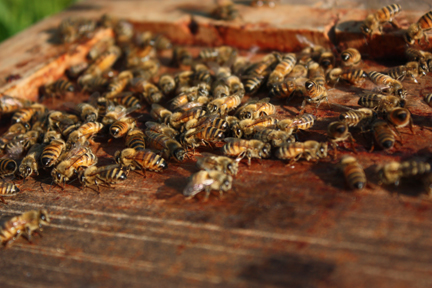
Here the bees hang out on the inside hive cover after I removed the top cover and gave them a few puffs of smoke to calm them.

This is what the hive looks like with 2 brood boxes on it sans outer cover.

With outer cover...

And here the bees are checking out their newly expanded digs.  The second brood box has been a couple weeks now and it is amazing to me how much air traffic there is to and from the hive.  It is nature at its finest and I could watch it all day.  It's also really cool at dusk just as the sun is setting many bees will hang out on the front porch to cool off a bit.

A Lame Pig!

~ 2 weeks ago our rescued potbellied pig, Morgan came up acutely lame.  Acute in that the day before she was fine and very mobile.  I knew something was wrong when Morgan barely wanted to get up and didn't want to come out of her stall.  I spoke with her veterinarian, Dr. Jean Feldma; an excellent large animal vet that I really like, and she had me start her on an NSAID similar to aspirin called Rimadyl.  We commonly use this at work as well for small animals so I amvery familiar with it.  While I truly believe this med helped with her pain it in no way made her problem go away.  I knew it was time to have Dr. Feldman come out to sedate her and take some x-rays.
Last friday Dr. Feldman stopped out and unlike the last time she came to trim her feet, Morgan did not bolt out of the barn and run like a fat little bullet across the yard.  Rather she laid there and allowed us to easily inject her in the butt with the anesthetic drug.  Within minutes of receiving the injection she was snoring and ready to be radiographed.  We ended up taking some very high quality diagnostic films using Dr. Feldman's mobile digital x-ray unit.  This is a JPEG of the actual x-ray...some image quality is lost in the conversion down to a web ready JPEG, but you get the idea.
It turns out that Morgan has severe arthritis in her left elbow.  It is so bad that it is to the point where we hope that it fuses so that while she may have a limp in her gait it will no longer cause her pain.  We took a shot of the right as well to compare and while that elbow also has arthritis it is no where near the severity of the left. 
We then injected the joint with a steroid and hopes of reducing the inflammation even more.  Lastly we trimmed her feet (the nails) which is next to impossible to do when she is awake.
The injection definitely helped because a few days later Morgan was more willing to come out of the barn to lay in the sun, which is her favorite activity aside from eating.  Yep she takes after her dad.  She even cooled off by venturing into the horse arena and lying in the mud from some rain the day before.  Something she rarely doe despite being a pig! 


So far she still has a limp and doesn't get up as easily but her pain seems less.  We are going to start her on the supplement OsteoBioFlex which Dr. Feldman has said can help with pig joints.  Most likely will re-start the Rimadyl which I stopped while she received the steroid injection.
While her life might be slightly different and she may have a limp forever we hope to keep her pain free for the rest of her life.  We adopted an old pig that needed a home and we knew that stuff like this was a possibility.  But she has a good life here and as long as she has a good quality of life we are happy.  She has been eating all along and that is always a good sign.

Monday, May 23, 2011

Blog Posts Still Missing

Blogger has yet to fix the problem that lead to the disappearance of the last several posts that I made last week.  I want to apologize to all my loyal readers (over 500 per month!)  The last thing I want to do is to try and re-create the posts as they were...it would be impossible!  Not only do I not know exactly what I wrote but I am not sure what images went where.  I have very early drafts saved that do not include any of the final edits.  With that being said I am patiently for their recovery and I appreciate your understanding for something that is entirely out of my hands.  To make you feel better I will share with you some photos!

This is our rescued potbellied pig, Morgan Sophia Beasley, catching some sun over a month ago in between rainy days...the grass and everything else has gotten lush and green since then!


This is our black capped golden Polish chicken...that stunning "hat" is straight out of the Royal Wedding or the Kentucky Derby!

Monday, May 16, 2011

LOST POSTS!!!! Blogger Down!

Blogger had a scheduled maintenance sometime shortly after I posted the last several updates.  However in doing so they lost some 30 hours of posts including all of mine.  I am told that they are working on it and hope to have these recovered.  I truly hope so because I really don't want to redo what I already did!
http://www.washingtonpost.com/blogs/faster-forward/post/blogger-begins-restoring-posts-as-outage-continues/2011/05/13/AF3OTe2G_blog.html

Tuesday, May 3, 2011

New Bees Arrive at Czarina of the Woods Farm

I ordered a 3 pound package of bees to replace my hive that died over this past winter.  You can read about that here:  http://czarofthewoodsfarm.blogspot.com/2011/03/bee-death.html  Yep, I ordered the bees from an apiary in Ohio called Waldo Apiaries and they arrived via the United States Postal Service this past Thursday.  While at work I received a call from the local post office to tell me that the bees had arrived.  When I picked them up the postman said that he had never dealt with bees in the mail before.  They come in a box with open sides and it was alive with ~ 3000-5000 Italian bees and one Russian Queen bee, hence Czarina.  It seemed fitting that I went with a Russian queen bee since the farm is well, Czar of the Woods Farm.  In reality though it was a practical choice because they are a little bit hardier which is good for our harsh winters.  


So inside the box the queen is inside a tiny little chambers that is sealed off with sugar candy, which acts as food for her and the few helper bees that are put inside with her to tend to her needs, and then capped off with tiny corks.  Keeping her separate ensures that the other bees will get to know that she is their queen and that she won't escape.  The day before they didn't even know each other.  By the time the box package is placed in the hive she will be well on her way to chewing herself out of the chamber (I did have to remove the one cork) and will be united with HER bees. 


Sadly the weather on the day that the bees arrived was less than ideal for putting the package in the hive so they stayed in my cool dark basement until Saturday morning (Thursday was too windy and Friday was rain, both weather conditions do not make bees happy).  While in the basement I had to feed them by spraying the box with sugar water.  There is also a can of suger water that is built into the package to feed them. They seemed content but I was nervously watching them for fear of them dying.  A 3# package of bees costs over $100 including shipping.  Not cheap.
This past Saturday I opened up the hive which is located in the northeast corner of the property and removed 4 frames (that were heavy with honey and comb from the previous hive despite them dying off).  I then had to open the box package and place the queen chamber (with the queen in it) on the bottom of the hive by itself.  All the time the bees that are most likely a bit stir crazy at this point are beginning to pour out of a very small hole at the top of the package box.  My anxiety level is very high as I don't want it to go wrong or lose any bees.  The package fit perfectly and is thus made that way to be the exact width of the 4 frames that I removed.  Now I would have to let the hive sit for 2 days to give them time make themselves at home and for them to accept their queen.
Two days put me to Monday morning but I did not want to rush things before work, they would have to wait until after work.  When I opened the hive most of the bees had left the package and were in the hive itself.  I was pretty stressed to find that the Queen had already chewed herself out of the chamber meaning that she was free in the hive.  I did not want her to escape yet I couldn't slow down to take time to identify her, this is possible by the way, but rather I needed to get in and get out.  Many bees were flying out of the hive as I worked and I feared losing them as well but they all seemed to be coming back or landing on my white bee suit.  I was surprised to find that in a very short period of time the bees had begun creating comb in the empty space where the frames once were (the package box is in this space but only takes up 2/3 the depth and like I said fits exactly in the 4 frame width).  This comb was suspended from the inside cover and is known as bur comb because it isn't organized on the frames.  I had to smoke the bees off of this in order to remove it from the hive so that, once i pulled the box out that they came in, I could replace those 4 frames.
Smoking the bees keeps them workable and slightly sedate.  I often wonder if it burns their eyes but it is a must when working with them.  As I did this the bees went down into the hive and up along the 6 remaining frames.  It appeared to be going well but I can't tell you how intense this was.  I pulled the mostly empty package box out which they had already begun sealing into the hive with their bee "glue" know as propylus.  It took a bit of effort to loosen and extract, all things leading to more intense anxiety.  I removed all the rest of the bees from the package and got them into the hive.  Once I was certain that most bees, as many as I could wrangle anyway, were safely in the hive I closed it up and I will not open it for one week.  Still a bit worried that the queen might have escaped, but I'm pretty sure she didn't
Typically you have to out a hive top feeder on a new hive with very rich sugar water in it but since the hive frames are heavy with pre-existing honey they can live on this for a while.  Once the weather stays nice they will be able to find plenty of food out in their 3 mile radius.
Phew!  New bees have arrive at Czar of the Woods Farm....FINALLY!  Thanks to Steve Mead, my beekeeping mentor, for his advice on installing a package of bees into a hive.

Saturday, April 16, 2011

Bald Eagle Cam

Please do yourself a favor and check out this live web cam of a bald eagle nest in Decorah, Ioaw.  It is simply put, stunning!  http://sportsmansparadiseonline.com/Decorah_Bald_Eagle_Nest.html
The nest itself weighs 1/2 a ton and is 80 ft above a river.  Pretty amazing that these birds can deal with some pretty rough weather and wind up there.  The two parents are so very attentive to the needs of their 3 babies.  Makes one realize why this majestic bird is the national bird of the U.S.
Thanks Pat for getting me hooked on this!  :)

Monday, April 4, 2011

There Will Bee...

I lost my bee hive this winter as I posted about here: http://czarofthewoodsfarm.blogspot.com/2011/03/bee-death.html   While it is very sad and discouraging after all the work I had put into it last year I am happy to say that I have ordered a new package of bees from Waldo Apiary in Ohio.  They ship on April 27th and I will then start anew by placing them in the hive and letting them do their thing.  It will be prefect timing for all the spring blooms and buttercups that are out as spring bursts forth come May.  I ordered a 3 pound package of bees and upgraded to a Russian queen which I am told are hardier for our weather.  It felt right seeing that our farm's name is Czar of the Woods Farm to have a Russian Czarina queen bee running the apiary dept!
I will certainly post photos and the process of adding the package into the hive once the arrive here.  Hopefully our mailman is not allergic :)
Sorry for the lack of posting lately...MUD MUD MUD about sums it up.  Winter is lingering this year like a stink in the bathroom.  No longer fun.  Can't wait to get my hands in the dirt...I did plant about 100 bulbs of various spring blooming flowers.  Hoping that they grow quickly to add a bit of color to the grey and brown landscape.